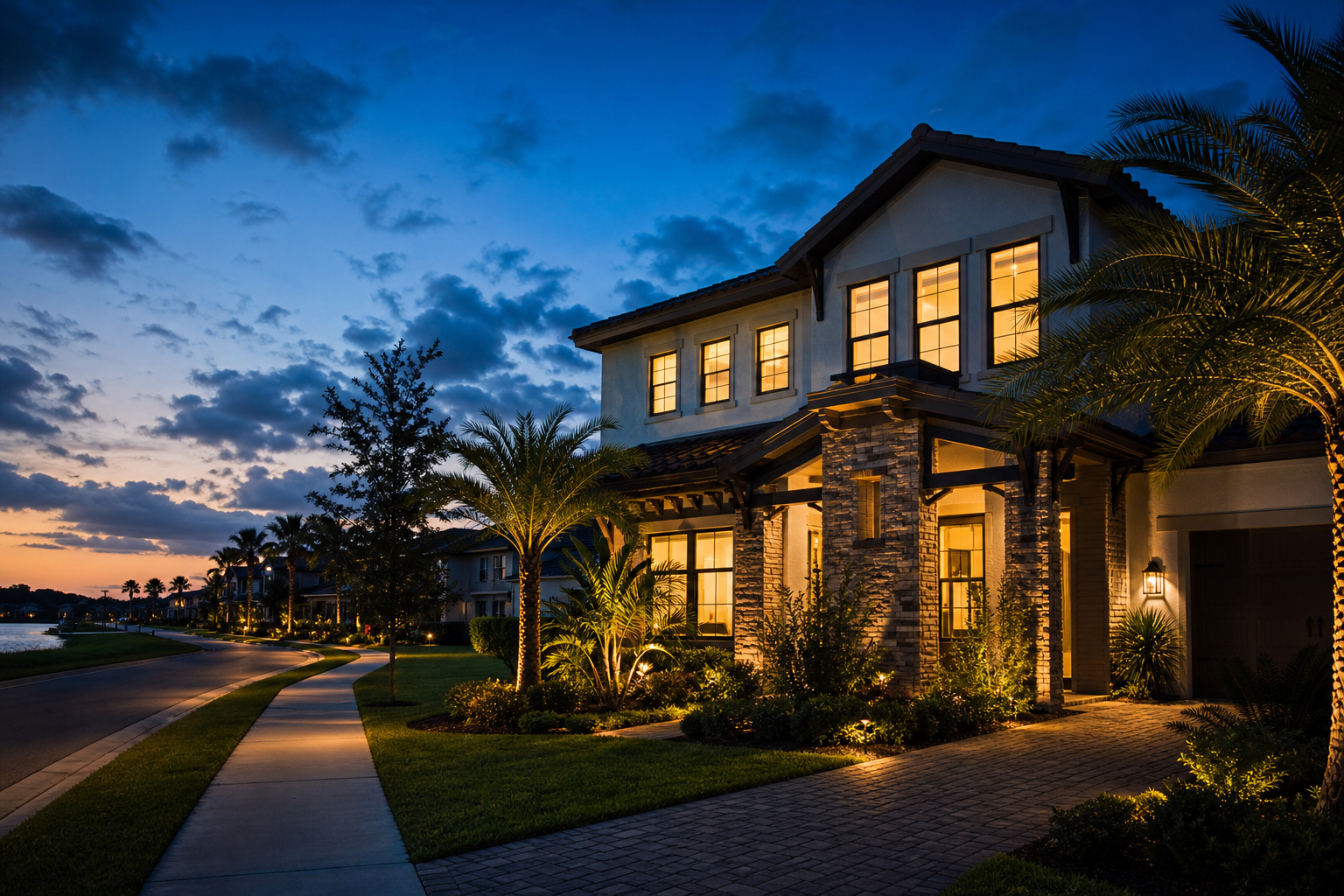
Horizon West is a master-planned community in western Orange County built around a village classification system, with plans for 42,000 residential units and a projected population near 100,000 at full build-out. It is one of Central Florida's fastest-growing areas, with active transportation investments and ongoing commercial and residential development.
How is Horizon West shaping Orlando's future?
Horizon West is a master-planned community in western Orange County built around a village classification system established in 1995. With plans for 42,000 residential units across five villages and a town center, and a projected population near 100,000 at full build-out, it is one of the largest planned growth corridors in Central Florida. As of 2026, the community is still actively expanding, with Orange County advancing major transportation improvements and new residential and commercial phases continuing to come online.
Key Takeaways
- Orange County's plan for Horizon West calls for 42,000 residential units across five villages and a town center at full build-out.
- A January 2020 report estimated Horizon West was roughly 52% built out at that time, meaning significant new development remains ahead for buyers and investors tracking this corridor.
- In January 2026, Orange County announced major transportation improvements tied directly to Horizon West's long-range sector plan, addressing congestion as growth continues.
- A Disney-backed mixed-income housing project near Magic Kingdom received approval in October 2024 for 1,369 units, 1,000 of them designated affordable, reinforcing the area's role as a workforce housing corridor for one of Central Florida's largest employers.
- Each Horizon West village was designed with embedded elementary schools, parks, and neighborhood centers, creating a more self-contained lifestyle than older suburban patterns elsewhere in the Orlando region.
What makes Horizon West different from other Orlando suburbs?
Most of Orlando's older suburbs grew organically, a subdivision here, a strip mall there, roads added reactively as traffic worsened. Horizon West was built the other way around.
In 1995, Orange County commissioned a comprehensive study that laid out a framework for more than 21,000 acres of western Orange County, designating land uses, infrastructure corridors, and a village classification system before a single house was built. That document is still the backbone of how Horizon West develops today.
The result is a community that feels intentional. Each village is designed to include its own residential neighborhoods, elementary school, village center, parks, and a mix of commercial uses. The idea is that residents can meet everyday needs close to home rather than driving across the metro for everything.
According to Orange County's official Horizon West overview, the plan calls for five residential villages plus a town center, with an ultimate build-out of 42,000 residential units. The Florida Agency for Health Care Administration has cited long-term projections of approximately 105,000 residents at full build-out, making Horizon West comparable in scale to a mid-sized Florida city on its own.
That kind of scale has consequences for how you think about a home purchase here. You are not buying into a finished neighborhood. You are buying into a community that is still being built, with more retail, more schools, more parks, and more infrastructure coming in stages over the next several years. For some buyers, that is a reason to wait. For many others, it is exactly the opportunity they are looking for.
I work throughout western Orange County, and the question I hear most often about Horizon West is some version of: "Is it too built up already, or is there still upside?" The honest answer is that it sits in an interesting middle stage. A January 2020 report from the Orange Observer estimated the community was about 52% built out at that time, with roughly 21,292 units platted or built out of an approved 40,282. That was six years ago. The community has grown substantially since, but the framework still points to meaningful development ahead.
The villages: how they differ and what that means for buyers
Horizon West is not one neighborhood, it is a collection of distinct villages, each with its own character and stage of development. The named villages include Lakeside, Bridgewater, Village F, Hickory Nut (Village H), Village I, and the Town Center.
The Town Center is designed as the regional core, higher density, mixed use, and the commercial and civic heart of the broader community. The surrounding villages are more residential in character, each with neighborhood-scale amenities built in from the planning stage.
What this means practically: a buyer in Bridgewater and a buyer in Village I are in the same master-planned community, but they may be in different phases of build-out, served by different schools, and looking at different mixes of new construction versus resale inventory. That distinction matters when you are pricing a home, evaluating HOA structures, or thinking about how a neighborhood will look in five years.
This is the kind of hyperlocal detail that gets lost when people talk about "Horizon West real estate" as a single category. If you want to understand how the Orlando Housing Market in 2026 plays out at the village level, the only way to do it accurately is to look at each area on its own terms.
What is driving Horizon West's growth in 2026?
Two things stand out when I look at what is actively shaping Horizon West right now: transportation investment and workforce housing.
Transportation infrastructure catching up to growth
In January 2026, Orange County announced it is advancing major transportation improvements in Horizon West, explicitly tying those projects to the long-range sector plan adopted more than 30 years earlier. The county's framing is notable: infrastructure is being coordinated to support new development proactively, not added reactively after congestion becomes a crisis.
For residents and buyers, congestion has been a real concern as the community has grown. Roads that were sized for a partially built community are now handling significantly more traffic. The county's 2026 commitment to transportation improvements is a direct response to that pressure, and it matters for how commute patterns and connectivity evolve over the next few years.
Anyone buying in Horizon West with a commute to downtown Orlando, the theme park corridor, or the airport should factor in current travel times and watch how the transportation projects roll out. Your commute today and your commute in three years may look different.
Workforce housing and the Disney connection
One of the more significant developments in the western Orange County corridor came in October 2024, when a Disney-backed mixed-income housing project received county approval. Developed by The Michaels Organization, the project calls for 1,369 units a few miles from Magic Kingdom, with 1,000 of them designated as affordable. Conditions of approval require that 75% of the homes be accessible to households earning between 50% and 100% of the Orlando area median family income, with construction anticipated to span roughly 2025 through 2027.
This matters for how you think about the broader Horizon West corridor. The community is not just a for-sale new construction market. It sits within a strategic workforce housing zone tied to one of Central Florida's largest employers, with a mix of master-planned communities, townhomes, apartments, and mixed-income projects all developing in parallel. That diversity of housing types and price points shapes who lives here, what rental demand looks like, and how the area matures over time.
For investors, that context is worth understanding before making a decision based on new construction price points alone. For long-term homeowners, it reinforces that Horizon West is being built to accommodate a broad cross-section of the workforce, which tends to support sustained demand.
How Horizon West compares to nearby West Orange communities
Buyers comparing Horizon West to established areas like Winter Garden, Windermere, or Dr. Phillips are often surprised by how different the considerations are. Windermere and Dr. Phillips are largely built out, with resale inventory dominating and a different price tier. Horizon West offers more new construction options at a range of price points, but with the trade-offs that come with a community still mid-build: some roads not yet complete, retail still opening, and the general feel of active construction in certain phases.
For a direct look at how price points compare across western Orange County, recent local market data shows the area median sale price in Ocoee at $420,000 with a median of 59 days on market, while Windermere's median sits at $847,500 with a median of 52 days on market. Horizon West spans a wide range within those bookends depending on village, builder, and product type.
| Area | Median Sale Price | Median Days on Market |
|---|---|---|
| Ocoee | $420,000 | 59 |
| Windermere | $847,500 | 52 |
These are area-level medians from recent local market data, an individual home's value depends on condition, street, build year, and timing. If you want to know where a specific Horizon West address fits in that picture, that requires a property-level analysis, not a zip code average.
Comparing Horizon West to communities like Lake Nona, Dr. Phillips, and MetroWest also brings up commute patterns, HOA structures, and proximity to employment centers, all of which vary significantly by location and household priorities. I walk buyers through those trade-offs every week, and the right answer is almost never the same twice.
Buyers considering Horizon West should also think carefully about new construction versus resale. Builders in active villages offer incentives on inventory homes, and those incentives are sometimes negotiable, but the process of buying new construction has its own timing, contract structures, and due diligence requirements that differ from a resale transaction. Having someone in your corner who knows the builders active in a specific village is worth more than the builder's on-site sales team alone.
I have been working with buyers and sellers throughout western Orange County for more than two decades. If you want an honest read on where Horizon West fits for your specific situation, whether you are relocating, investing, or moving within Central Florida, I am happy to run through it with you. Reach out to schedule a conversation.
You can read what my clients say about working with me on Google, Zillow, and Realtor.com.
Frequently Asked Questions About Horizon West
How far along is Horizon West's build-out, and what does that mean for buyers?
As of a January 2020 report, Horizon West was approximately 52% built out, with around 21,292 units platted or built out of an approved 40,282. The community has continued growing since then, but Orange County's plan for 42,000 total units means significant new construction, commercial infill, and infrastructure delivery remain ahead. For buyers, that mid-stage position means more new construction options than a fully built community, but also more active development in the surrounding area as phases continue to complete.
Is Horizon West a good location if I work in Orlando or near the theme parks?
Horizon West sits in western Orange County, which puts it within reasonable range of the theme park corridor and the broader Orlando metro. Commute times depend heavily on which part of Horizon West you live in and where you are going, and congestion has been a real issue as the community has grown. Orange County announced major transportation improvements in January 2026 specifically to address that pressure, so connectivity should improve, but anyone with a daily commute should test drive the route at rush hour before committing to a specific neighborhood.
What are the main villages in Horizon West, and how do they differ?
Horizon West includes named villages such as Lakeside, Bridgewater, Village F, Hickory Nut (Village H), Village I, and a Town Center that serves as the community's regional core. Each village was designed with embedded schools, parks, and neighborhood-scale commercial uses, but they are at different stages of build-out and have different mixes of new construction and resale inventory. The right village for a given buyer depends on price point, school preferences, proximity to work, and how much active construction they are comfortable living near.
Why is Horizon West considered one of Central Florida's fastest-growing master-planned communities?
Orange County's own 2026 transportation announcement describes Horizon West as having transformed from rural land into one of Central Florida's fastest-growing master-planned communities, driven by a village classification system that has guided land use and infrastructure since the mid-1990s. With an ultimate projected population near 100,000 to 105,000 at full build-out, Horizon West is comparable in scale to a mid-sized Florida city, and it is still actively expanding, which is what distinguishes it from most other suburban communities in the region.
Is Horizon West better for long-term homeowners or investors?
It can work for both, but the calculus is different. Long-term homeowners benefit from a community that is becoming more self-contained and amenity-rich with each new phase, with schools, parks, and retail continuing to open. Investors should look at the full picture: Horizon West sits within a workforce housing corridor tied to one of Central Florida's largest employers, with a mix of for-sale, rental, and mixed-income housing all developing in parallel. The right investment strategy depends on product type, village location, and holding timeline, and those details are worth working through with someone who tracks this market closely.
Equal Housing Opportunity. Eve Metlis is licensed with Watson Realty Corp., regulated by the Florida Department of Business and Professional Regulation (DBPR). This article is general information only and is not legal, tax, or financial advice, confirm your specific numbers and circumstances with your title company, tax advisor, or lender. All information is deemed reliable but not guaranteed; measurements are approximate and buyers or their agents should verify all critical details.